x

Detroit Pollinator Habitat Kits

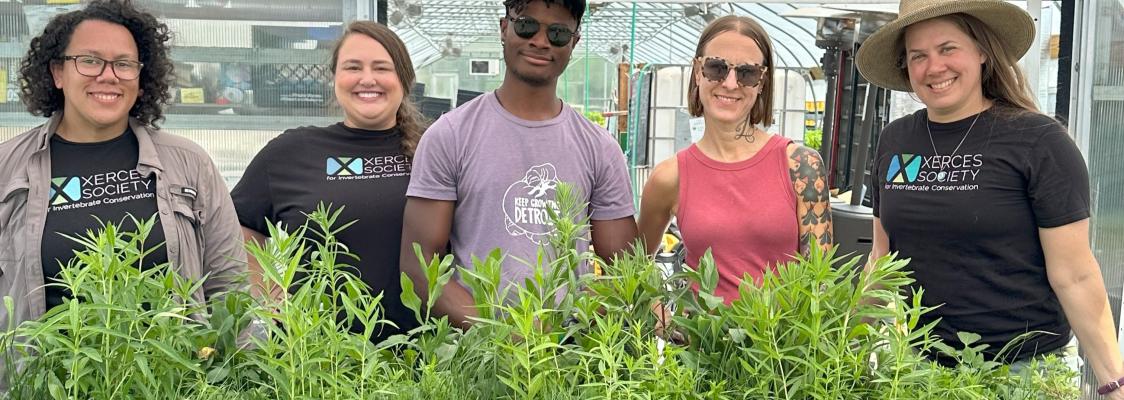
2023 Detroit Pollinator Habitat Kit Distribution at Keep Growing Detroit. Pictured left to right: Stefanie Steele / Xerces, Kailee Slusser / Xerces, Akello Karamoko / Keep Growing Detroit, Roanna Cooper / volunteer, Deborah Seiler / Xerces. Photo by KGD.

With approximately 843 species of butterflies and moths and 465 species of bees, Michigan has an impressive diversity of insect pollinators. Across the country, pollinator habitat has been lost due to urban development, including the monarch butterfly, which was recently proposed as a listed threatened species under the Endangered Species Act. However, urban farms and community gardens in Detroit and the Metro Detroit area have a unique opportunity to increase habitat for pollinators and other beneficial insects such as predatory beetles, syrphid flies, solitary wasps, and lacewings. Both pollinators and beneficial insects provide important services in urban landscapes, especially farms and gardens. Fortunately, many pollinators can thrive in urban areas where landscaping includes a diversity of native flowering plant species free of pesticides.

To this end, the Xerces Society is offering pollinator habitat kits that contain regionally adapted native plants to community-serving urban farms, gardens, and local community organizations. The cost of the kits will be covered by the Xerces Society, and selected project partners are responsible for pick-up of the kits, planting, watering, maintenance, and submitting follow-up informational surveys and photos.
 

A link to the proposal form is located in the “Proposal Form” section below.
 

Please share your contact information with us to receive reminders about these dates and updates on the pollinator habitat kit program, as well as other Xerces news and events for Metro Detroit and the Great Lakes.


Watch our Detroit Habitat Kit Program Highlight Video.


Learn more

Qualifying Projects
Eligible project sites for the Detroit Habitat Kit Program include community-serving urban farms and gardens, community gardens, and community organizations with green space in Detroit and the Metro Detroit area. Please note that at this time, residential gardens are not priority project sites.


Locations
Priority areas for kit partners are within:

  • Detroit 
  • Detroit Metro area

Those outside of, but near the priority area, may be considered, but partners will need to drive to Detroit to pick up their kit from Keep Growing Detroit. If you are near the priority region and interested in participating, please contact stefanie.steele@xerces.org.

Timeline
This is an overview of the entire habitat kit process from project proposal to final report. For more information about each step, please read the sections below. 
 

Date(s)

Task

February 9th to March 19th

Submit a Proposal Form

April 7th

Notification of selection via email

April 14th

Sign the Project Partner Collaborative Agreement. 

By end of May

Site preparation

End of May

Kit distribution +

Invitation to Mighty Networks via email

By end of June

Plant your kit and submit a Planting Notification Form (PNF)

December 17, 2027

Submit a Final Report

Proposals for the 2026 habitat kit season will be open from February 9th through March 19th

  • During this open proposal period, Stefanie encourages interested participants to schedule on-site, in-person field visits to discuss projects in person. Email stefanie.steele@xerces.org
  • We estimate this form will take about 45 minutes, and please have pictures of your proposed planting location available.

If there are any changes to this timeline, updates will be posted here.
 

Proposal Form Outline:

  • Introduction and Resources
  • Participant Information
    • Contact
    • Affiliation
    • Tell us about you - how does access to this kit fit into and support your community's ongoing work?
    • Disclose any federal financial or technical assistance
  • Project Site Details
    • Project Name
    • Location
    • Request an in-person site visit
  • Kit Type and Description
    • Review the plant list with general requirements to determine if you are a match
    • Disclose if you have been awarded a habitat kit in the past
    • Request the number of kits 
    • Confirm ability to pick up kits
  • Specific Habitat Project Plan
    • Description of habitat kit planting motivations
    • Description of planting location
    • Space available for planting in square feet (area = length X width)
    • Current conditions/existing vegetation
    • Site preparation and watering plan
    • Plant care and protection after planting
    • Long-term maintenance and support
    • Heavy metal testing
    • Upload photos of the proposed planting area
  • Protection from Pesticides
    • Pesticide use practices within and near the site (including organic methods)
  • Outreach, Education, Community Science
    • Who will benefit from the plants? Will you integrate planted habitat into outreach and education opportunities? - This is highly favorable 
    • Capacity to contribute or promote community science initiatives?
  • Final Program Logistics
    • Agreement to submit the Planting Notification Form and Final Report
    • Agree to pick up the kit or disclose alternative arrangements 
    • Next steps overview
    • Acknowledgement
       

If you are unable to complete this form via Google Forms, please reach out to stefanie.steele@xercess.org for assistance.


Submit a Proposal


Detroit Urban Soils in Full to Part-Sun
  • Kits are to be used to create or enhance permanent native habitat for monarchs, pollinators, and other beneficial insects (e.g., predatory beetles, syrphid flies, predatory and parasitoid wasps, lacewings) on community-serving urban farms, gardens, or other community spaces with green space. The kits will include a diverse mix of native plants, suitable for the Detroit region and urban soils. 
  • Detroit Pollinator Habitat Kits each include 5 trays of plants, each with 32 two-inch pots, and 1 tray of 8 quart pots from KGD.
  • We suggest plants be spaced 1 to 2 feet apart (18-inch spacing requires 375 sq ft). Denser spacing will be more competitive with undesirable, weedy plants, and your habitat will appear fuller faster.
  • Most Habitat Kit plants are resistant to deer and rabbits, but these and other animals may still browse and taste them. Protect with fencing if these animals are present.

Detroit Urban Soils in Full to Part-Sun Plant List


To see mature kits, click on the “previous projects” button or watch our Detroit Habitat Kit Program Highlight Video.


All kits will come with one English “Pollinator Habitat” sign and a metal u-post to display the sign, and individual metal signs to label the kit plants. Spanish and Arabic translated signs are also available for kit partners.

Photo: Xerces Pollinator Habitat signs in English, Spanish, and Arabic. Photo: Stefanie Steele / Xerces Society.


Note: Plant species may be subject to change based on annual production and inventory. We do our best to work with our nursery partners to design habitat kits in advance and do not anticipate significant changes to kits. However, there are instances where nurseries may experience unexpected production issues for a particular species in a given year. Xerces staff frequently check in with our nursery partners to track plant orders, and we will notify project partners of any species substitutions or other changes to the kits before kit distribution, with as much advanced notice as possible.

Kits will be available for pick-up around the last Saturday of May. 
More details regarding habitat kit distribution will be available if/when your proposal is accepted.


Distribution Locations
Keep Growing Detroit: 3100 Orleans St, Detroit, MI 48207

Habitat kit distribution set-up at KGD. Photo: Stefanie Steele / Xerces Society.


Transportation Tips
Tips, including space requirements and container sizes: Coming soon!

Example of a kit in the back of a car with the seats folded down. Photo: Stefanie Steele / Xerces Society.
 

Note: You must submit the Project Partner Collaborative Agreement before receiving your kit(s).

Reporting is critical to the work that Xerces does, and we cannot count the results of your planting if you do not complete the required reporting. The information provided by all Habitat Kit participants helps Xerces update and improve the science-based conservation resources we offer through our website, training courses, and webinars.


Planting Notification Form (PNF)
This report confirms the planting at the project site with photo proof. 
Please submit your PNF by June 30, 2026.


Final Report
This report provides more information on the establishment of the plants. 
Please submit your Final Report by December 17, 2027.


If you are awarded a kit, you will receive a Project Partner Collaborative Agreement (PPCA) that outlines all specific reporting requirements.
 

For more information, please review the Detroit Pollinator Habitat Kit Planting and Maintenance Guide (coming soon!).


Detroit Participants - Permitting is Protection
From KGD and Sustainability Department: “Permitting helps protect your garden or farm and clarifies your responsibilities as a landowner. It signals to the City that your space is covered under Detroit’s Urban Agriculture Ordinance, giving you additional legal rights and recognition. Check out the linked guides for more detailed information for urban farmers.
 

Site Preparation

  • Site prep should be completed before receiving the plants, or within the first two weeks or so after pick-up. Proper site prep and timely planting will give the plants the best chance at survival.
  • Clear all weeds and existing vegetation to create bare ground to plant into. 
    • Tip: Compost is not a necessary soil amendment for native plantings, but a small garden trowel's worth in each plant's hole can be helpful for nutrients.
  • Mulch, such as wood chips or weed-free straw, is a very important tool to help reduce weeds in your new planting area and keep your soil moist.
    • Tip: Wood chips can often be sourced for free by contacting local arborists in the spring.
    • Tip: Accept a few logs
  • Make sure that the minimum space needed for the kit you requested will be available. Calculation for a rectangular bed: area = length X width. 
    • Tip: Use a spacing calculator if needed. Note: Xerces is unaffiliated with this linked organization; links are not product endorsements.
    • Tip: add borders, such as logs or other dead wood, rocks, bricks, or other edging to protect and create a visual intention of your habitat.
  • Create a long-term schedule for planting and post-planting management, including monitoring, watering, weeding, and other required maintenance activities. Organize work days and labor responsibilities. 
  • Resources:


Planting

  • The Detroit Pollinator Habitat Kit Planting and Maintenance Guide (coming soon!) provides detailed guidance on care and spacing. An example planting layout is provided at the end.
  • Tools: 
    • Keep Growing Detroit (KGD) Garden Resource Program (GRP) members are able to borrow tools such as shovels and pick up mulch from community hubs, or borrow a sod kicker from KGD.
    • With caution and care, a power drill with an auger attachment can be a helpful tool to plant more efficiently. 
    • Please use any tools at your own risk and be aware of foreign objects that may be in the soil as you work.
  • Hold a community work party day and/or regular days!
    • Preparing, planting, and maintaining a garden can be a lot of work, and we highly encourage you to reach out to those in your community and Stefanie for support in this process.
       

Maintenance

  • Protect plantings from animal damage and vandalism.
    • Tip: add borders, such as logs or other dead wood, rocks, bricks, or other edging to protect and create a visual intention of your habitat. Temporary fencing can add protection, too.
  • Control competing vegetation before and after planting. Weed control may be accomplished through hand pulling, smothering, hoeing, or other hand tools, mowing, or string-trimming. Take care not to damage desirable plants. Once plants are established, after year 1 or 2, they will be more competitive against weeds. 
    • Tip: Use individual pin flags to mark each native plant to help with identification.
    • Tip: Regular weeding while the competing vegetation is small.
  • During the first summer after planting, you may need to be prepared to water weekly.
    • Tip: Use your finger to check the soil moisture of your new habitat plants regularly and only water when the first few inches of soil are dry.
       
Sod kicker available for GRP members (left), power drill with plant auger attachment (right), community planting event, and demonstrating use of cardboard and wood chips (bottom). Photos: Loretta Powell, Stefanie Steele / Xerces Society.


Pollinator Conservation Resource Center
Here you'll find region-specific collections of publications, native plant and seed suppliers, and other resources to aid in planning, establishing, restoring, and maintaining pollinator habitat—as well as materials to help you learn about the species of invertebrates and native plants you might encounter.
 

Additional Information


Additional Information


Past Habitat Kit Resources

View program highlights: Detroit Habitat Kit Program Highlight Video


Blooming Habitat Kits

Thriving second-year habitat plantings with stone path planting in the spring (above) and wood borders and features in late summer (bottom). Photos:  Ruaa Bahran; Stefanie Steele / Xerces Society.


Site Preparation and Planting

Photos of Mary Thompson Farm and Community Garden from 2024: sod removal site prep (top), wood chip mulch application (left), planting into the soil under mulch (center), planted habitat protected by deer fence (right). Photos: Pat McLamore.


Thriving Beneficial Insects

Photos: Stefanie Steele / Xerces Society.


Who should I contact if I have questions?
You can contact Stefanie Steele, stefanie.steele@xerces.org, with any questions about our Detroit Pollinator Habitat Kit Program.
 

How do I participate in the Xerces Habitat Kit program?
Project partner proposal forms for the Detroit pollinator habitat kits will be available on February 9, 2026. The form asks for information about where the kit will be planted, size of the area, and plans for site preparation, management, and maintenance, as well as plans for pesticide risk mitigation and outreach opportunities, if applicable.
 

What is required of all selected kit partners?
All selected kit partners are asked to:

  • Have good communication with Stefanie - she is here to help, so please feel free to reach out!
  • Complete and return your Project Partner Collaborative Agreement (PPCA)  that outlines all requirements prior to picking up the kit.  
  • Prepare your site for planting your habitat kit plants - remove current vegetation, and we recommend laying down mulch (woodchips or weed-free straw) to cover your habitat area to minimize weeds.
  • Pick up your kit plants on time at the designated location, or inquire about other reasonable accommodations.
  • Until the kit plants are in the ground, water plants daily and keep them out of full sunlight to decrease stress.
  • Plant your kit plants within 2-4 weeks of receiving them (highly recommended for best survival success, but we understand delaying for periods of drought or other events).
  • Once the kit is planted, you must complete the provided planting notification form (PNF) to let us know your kit is planted and share a few photos.
  • In the summer of the same year, you are invited to an optional habitat kit partner gathering.
  • In the winter of the following year, you are asked to complete a final project report in a survey provided to you to provide more detailed information on the success of the planting, such as plant survival numbers, photos of plantings, comments on pollinator visitors, and outreach activities.
     

How many pollinator habitat kits can I request?
Interested partners may request 1 or 2 kits, but kits will be limited based on the number of project proposals received. Please let us know if you require a certain number of kits for your proposed project to be successful.


If I was an awarded kit partner in a previous year, am I eligible to submit another project proposal this year?
Yes, previously awarded kit partners from 2023-2025 may submit a 2026 project proposal, but please note that quality project proposals from first-time habitat kit partners will take first priority. This program receives more interest than kits available, and not all who submit a proposal will be awarded a kit.


What plants are in the kits?
Please see the above list of the tentative plant species, and other information will be available soon. The final plant list may minimally change as species are substituted/omitted depending on nursery availability.

How much space do I need for a kit?
For one kit, you will need approximately 300-350 square feet in total. See the plant list for the approximate size of each plant species. For herbaceous species, we recommend planting at 12-18 inch spacing. This closer spacing allows the plants to establish more densely and better out-compete weedy species that may otherwise pop up in the empty space between plants. 

When will the kits be available?
We are planning for kits to be available around the last weekend of May 2026 - more details soon. 

How do I get my kit?
Kits will be transported from Wildtype Native Plant Nursery and available for pick up at Keep Growing Detroit in Detroit, MI. More details to follow for recipients. 

Can I have the kit delivered to me?
It is strongly preferred that habitat kit partners pick up their kits from Keep Growing Detroit. Partners that are unable to pick up their habitat kit can submit a special request to see if delivery is available.

Can I purchase a kit on my own?
No, unfortunately, these kits are not available for public purchase. 

How did you decide what plants to include in the kits?
Plants were chosen to provide a diversity of foraging and host plant resources for native pollinators and beneficial insects (predators of common crop pests) on Detroit urban farms and gardens throughout the growing season. Feedback from past kit partners was taken into consideration, such as a preference for certain species or including more plants that could also be used by people. Other considerations that determined species selection included plant availability, as well as Detroit’s unique urban environment: plant suitability of urban soils, drought tolerance, and plant heights (~ 4 feet and shorter). Numerous sources were also consulted, including the Xerces Society’s Great Lakes Pollinator Resource Center (native plant lists, habitat installation guides), ERA Tool, Bill Schneider with Wildtype Native Plant Nursery, Mary Jamieson with Oakland University, and MSU’s Michigan Pollinator Initiative

Can I get technical assistance for creating a pollinator habitat, preparing for planting, and maintaining my kit?
Yes! We are happy to help as best we can within our capacity. You may contact stefanie.steele@xerces.org with questions about your project and for advice on how to ensure that your project will be successful. You can also find a variety of informational materials on our website. Please review the What Makes a Successful Habitat Kit Proposal and Planting document, and the planting guide for our Detroit Urban Ag Pollinator Habitat Kits. 
In-person assistance with your habitat kit site prep, planting, and management is also available on a limited basis, based on staff capacity - current and past kit partners are welcome to inquire with Stefanie! 

Can I use my habitat kit(s) in projects for which I am receiving financial assistance from the USDA Natural Resources Conservation Service (NRCS) or another federally funded agency? 
No, at this time, Detroit Pollinator Habitat Kits cannot be used to complete habitat work that a federal agency has funded, such as the NRCS.
If you want to learn more about NRCS programs or apply for financial assistance from the NRCS, please contact your local service center in Ann Arbor, or reach out to Stefanie Steele (stefanie.steele@xerces.org) for help in connecting with the appropriate conservation planner at the NRCS.   

I do not live in Detroit or the Metro Detroit area. Am I eligible for a kit?
At this time, we are providing kits to selected partners who will be planting them in the defined priority sites in Detroit and the surrounding Metro Detroit area. If you are just outside of the Metro Detroit area, please contact Stefanie to see if your site is applicable. If you are located outside of Michigan, we also have habitat kit programs in other regions of the U.S., and over time, we hope to expand the Xerces Society Habitat Kit Program to further parts of the country.

How can I support the Xerces Habitat Kit program?
The Detroit Pollinator Habitat Kits are possible thanks to the generosity of Xerces Society donors, members, and federal grant agreements with the USDA. Find out how you can support the Xerces Society at xerces.org/donate.

 

Contact Stefanie Steele, stefanie.steele@xerces.org, with any questions about our Detroit Pollinator Habitat Kit Program.


Meet our Detroit Pollinator Habitat Kit Team

Stefanie Steele

Pollinator Conservation Specialist
NRCS Partner Biologist
Urban and Small Farms

Community-Building Opportunities


Social Media
When posting about the Xerces Society Habitat Kit Program, you can help us spread the word about invertebrate and habitat conservation by including context about Xerces’ mission and our habitat kit program for any of your followers who don’t already know. Need some talking points? Click here for some key information to share about the Xerces Society Habitat Kit Program.

Please tag us in your posts so we can see your progress! Here are links to our social media pages: